

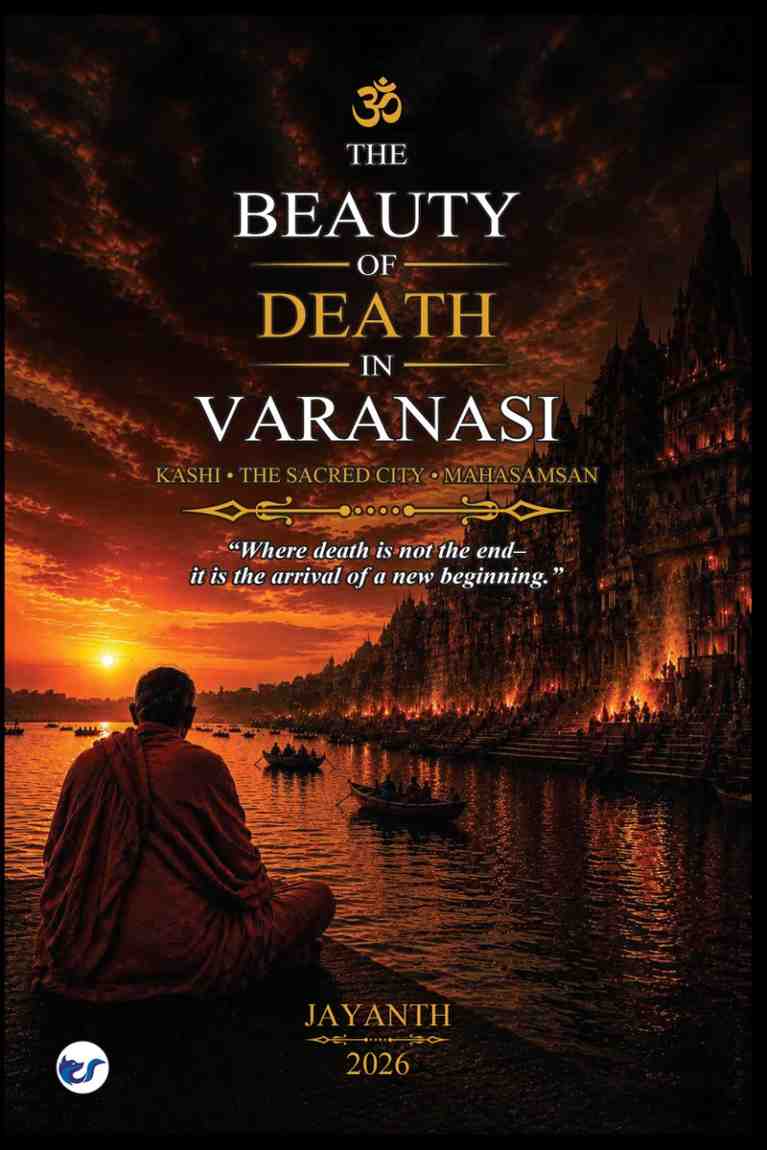





BEAUTY OF DEATH IN VARANASI Mahāśmaśāna Jayanth Karunika
There is a city on the banks of the Ganga where the dead are carried through narrow lanes on bamboo stretchers, where fires have burned without interruption for three thousand years, where dying is not hidden — it is witnessed, honoured, and understood as the most honest thing a human being will ever do.
This is Varanasi. And this book is about what it teaches.
Beauty of Death in Varanasi is a work of literary nonfiction that takes the reader inside the world’s oldest continuously inhabited city — not as a traveller, but as someone who has stood at the burning ghat at twenty years old, lit a pyre, and spent the years since sitting with what that morning was.
Jayanth Karunika writes about Manikarnika Ghat — the great cremation ground, the Mahāśmaśāna — with the precision of a reporter and the depth of someone for whom this is not material but memory. The book moves through eleven chapters and a river interlude, each one examining a different face of what Varanasi holds: the psychology of those who come here to die, the raw exposed grief that the city refuses to suppress, the Dom community whose sacred duty it is to keep the fire burning, the moment when a cremation stops being disturbing and becomes — unexpectedly, undeniably — beautiful.
The book also examines what Western visitors encounter when they stand at the ghat and feel something shift that they cannot name. It accounts for the economics of dying here — the wood, the workers, the priests, the thirteen days of ritual that follow. It follows the Ganga from her glacial origin to the precise curve at Varanasi where she flows north, back toward her source, in defiance of every other river on earth. And it ends where it must: with the question of what it means to let go of the things we carry, in the only city on earth that has been asking that question, out loud, at the edge of a fire, for longer than recorded history.
This is not a book about death. It is a book about what clarity looks like when a city refuses to lie to you.
For readers of William Dalrymple’s City of Djinns, Pico Iyer’s The Art of Stillness, and Atul Gawande’s Being Mortal.
Themes: Death and dying · Hindu philosophy and ritual · Sacred geography · Grief and acceptance · The Ganga · Indian cultural history · Literary travel writing · Mortality and meaning
From the author:
“I was twenty years old, and I did not know what I was doing. I have spent the years since trying to understand what I did. This book is that understanding, arrived at slowly, through repeated return to the city, to the fire, to the question. It belongs to everyone who has stood where I stood and not yet found the words for what they carried home.”
About the format: 11 chapters · River interlude · Foundation essay on Moksha and the theology of liberation · Literary nonfiction
 No products in the cart.







Reviews
There are no reviews yet.