

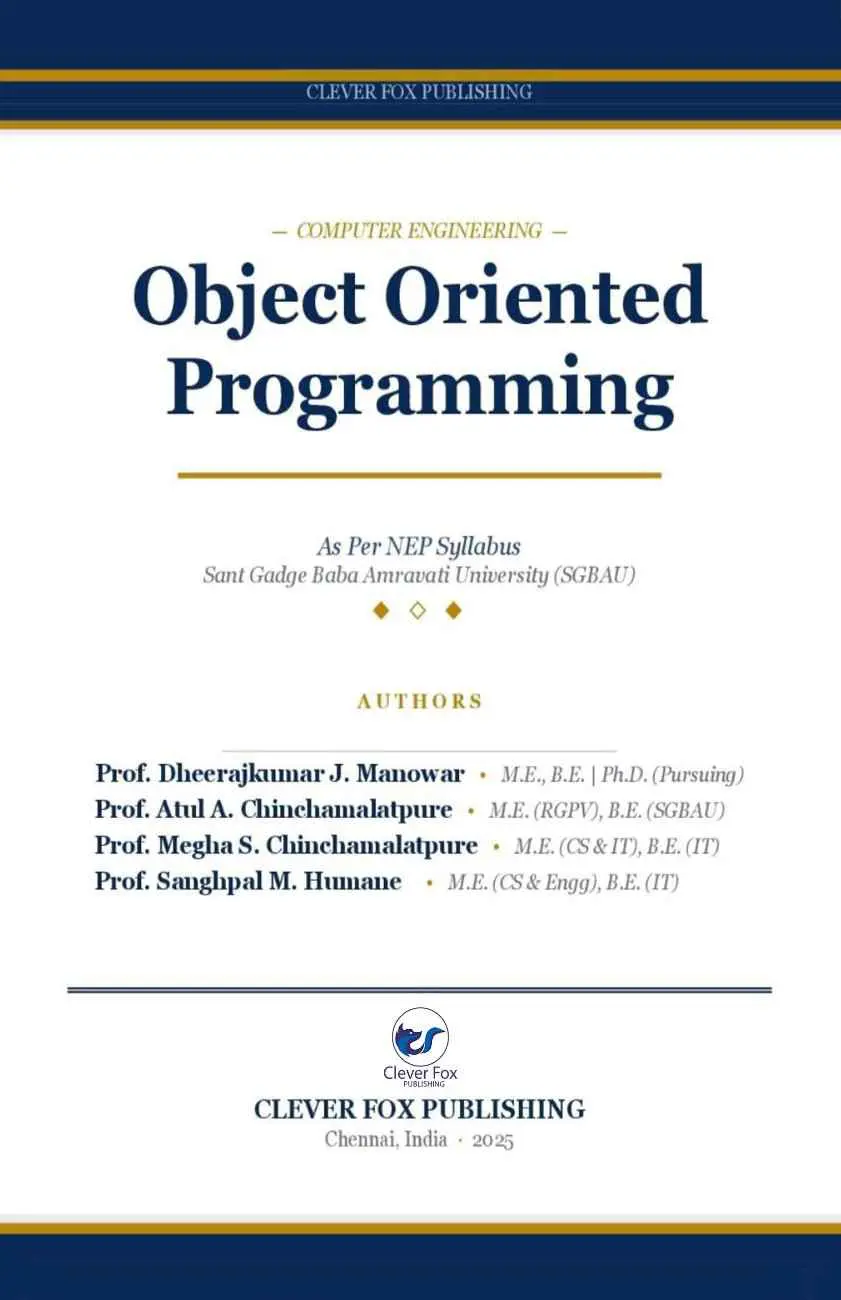




In the book Object Oriented Programming, published in 2025 by Clever Fox Publishing, several key themes and content areas are explored to align with the National Education Policy (NEP) syllabus for Sant Gadge Baba Amravati University (SGBAU).Foundational Concepts and ParadigmsThe book introduces the concept of a programming paradigm as a fundamental style for structuring problem-solving. It details the shift from Procedural Programming (like C or Pascal), which often suffered from difficulties in managing large codebases and a lack of real-world mapping, to the more intuitive, data-centric approach of Object-Oriented Programming (OOP).The Four Pillars of OOPA central theme is the mastery of the “Four Pillars” that form the conceptual backbone of the paradigm:Encapsulation: Bundling data and methods into a single unit while restricting direct access to ensure security and integrity.Inheritance: Creating new classes based on existing ones to promote code reuse and establish hierarchical relationships.Polymorphism: Allowing different objects to respond to the same message in unique ways, providing flexibility in system design.Abstraction: Hiding complex implementation details to show only necessary features to the user.Java-Specific Architecture and FeaturesThe textbook provides a deep dive into Java as a primary OOP language, covering:Java Virtual Machine (JVM): Its role in platform independence through the “Write Once, Run Anywhere” (WORA) principle.JDK, JRE, and JVM Relationship: Explaining the tools for development and the environment for execution.Security and Robustness: How Java enforces security via the Bytecode Verifier and Security Manager, and robustness through automatic memory management (Garbage Collection).Practical Programming and Advanced TopicsBeyond theory, the book includes technical content on:Programming Constructs: Variables, identifiers, literals, operators, and flow of control (loops and jump statements).Classes and Objects: Detailed instruction on creating objects, using constructors, and managing memory.Packages and Interfaces: Using packages for large-scale code organization and interfaces for full abstraction.Exception Handling and I/O: Managing errors through try-catch blocks and user-defined exceptions, as well as handling file input/output using the java.io package.GUI and Event Handling: Developing applications with the Abstract Window Toolkit (AWT) and understanding the Delegation Event Model.
Object-Oriented Programming
Estimated delivery dates: Jul 1, 2026 - Jul 6, 2026
₹399.00
Prof. Dheerajkumar J. Manowar is an experienced academician and researcher with over 15 years in engineering education. Currently pursuing a Ph.D. in advanced computing, he holds an M.E. and B.E. in Computer Engineering. His research, spanning 12 publications, focuses on medical image processing, data compression, and applied cryptography. A recipient of the MaTPO Young Achiever Award and a Life Member of ISTE, he actively leads initiatives in industry–academia innovation.
Contact:djmanowar@tietdarapur.ac.in | dheeraj.manowar@gmail.com
Prof. Atul A. Chinchamalatpure is a seasoned academician and researcher with over 15 years of experience in engineering education. He holds a B.E. in Computer Engineering from SGBAU Amravati and an M.E. from RGPV Bhopal. His research, documented in 12 publications, focuses on medical image processing, data compression, and applied cryptography. A Life Member of ISTE, he is actively involved in academic leadership and industry-academia collaborations.
Contact: aac@tietdarapur.ac.in | 1212.atul@gmail.com
Prof. Megha S. Chinchamalatpure is an academician and researcher with over 7 years of experience in engineering education. She holds a B.E. in Information Technology and an M.E. in Computer Science Information Technology from Sant Gadge Baba Amravati University. With a strong background in teaching programming, she is also actively involved in academic leadership and initiatives that foster industry–academia innovation.
Contact: megha.chinchamalatpure@gmail.comProf. Sanghpal M. Humane is an academician and researcher with over 13 years of experience in engineering education. He holds a Bachelor of Engineering (B.E.) degree in Information Technology from the University of Nagpur and a Master of Engineering (M.E.) degree in Computer Science and Engineering from Sant Gadge Baba Amravati University.He has been actively involved in teaching programming for more than 13 years, contributing to the academic development of students through his expertise and dedication.
Contact: Email: humanesanghpal@gmail.com
Description
Additional Information
| Weight | 0.5 kg |
|---|---|
| Dimensions | 21.6 × 14 × 3.5 cm |
| Binding Type | Paperback |
| Languages | |
| Publishers |
Reviews
Only logged in customers who have purchased this product may leave a review.
![பாதங்களை பாதுகாப்போம்[paadhangalai paadhukaappom]: கால் பிரச்சனைகளை தடுக்ககூடிய வழிகாட்டி[kaal pirachanaiygalai thadukka koodiya vazhikaatti]](https://www.ziffybees.com/wp-content/smush-webp/2026/06/PaadhangalaiPaadhukaappom1-150x150.jpg.webp)
![பாதங்களை பாதுகாப்போம்[paadhangalai paadhukaappom]: கால் பிரச்சனைகளை தடுக்ககூடிய வழிகாட்டி[kaal pirachanaiygalai thadukka koodiya vazhikaatti]](https://www.ziffybees.com/wp-content/smush-webp/2026/06/PaadhangalaiPaadhukaappom1-100x100.jpg.webp)
![பாதங்களை பாதுகாப்போம்[paadhangalai paadhukaappom]: கால் பிரச்சனைகளை தடுக்ககூடிய வழிகாட்டி[kaal pirachanaiygalai thadukka koodiya vazhikaatti]](https://www.ziffybees.com/wp-content/smush-webp/2026/06/PaadhangalaiPaadhukaappom1-320x495.jpg.webp)






Reviews
There are no reviews yet.