

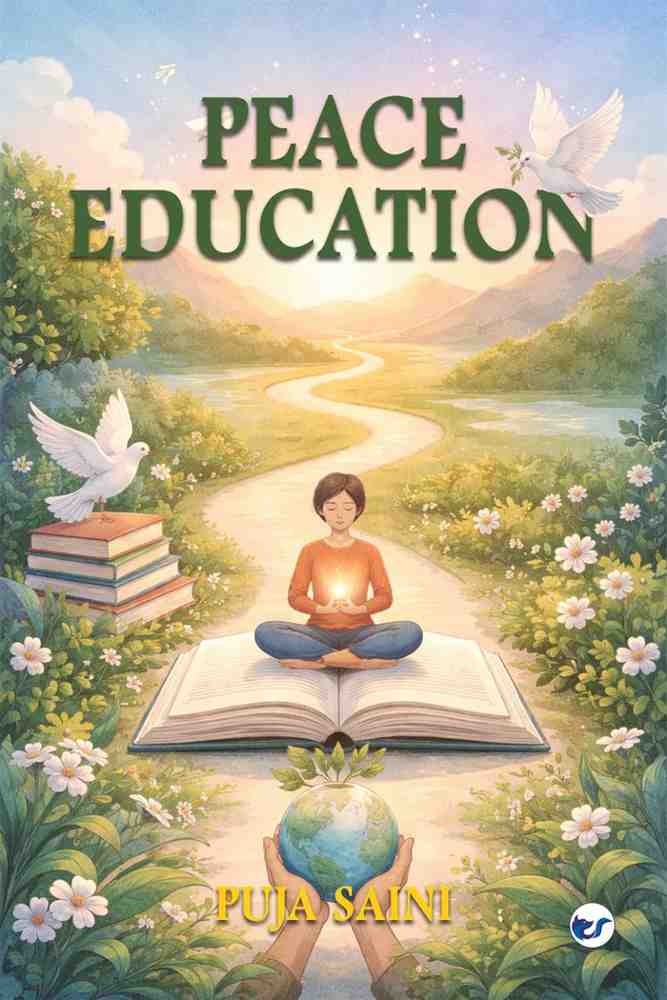


Peace is not just an idea—it is a way of living, learning, and becoming.
In today’s world, where conflict, stress, and social tensions continue to rise, Peace Education has become essential for building emotionally balanced individuals and harmonious communities. This book offers a comprehensive, practical, and inspiring guide to understanding peace and teaching it effectively in modern classrooms.
Designed especially for B.Ed, ITEP, and M.Ed students, as well as teachers, academicians, and education enthusiasts, the book covers the complete syllabus requirements of these programmes. It serves as a reliable textbook that blends theory with practical insights, making it useful for both examinations and classroom application.
The book explores peace from philosophical, psychological, social, cultural, and spiritual perspectives. It explains peace as a universal value, the need for inner harmony, and the relevance of peace in contemporary society marked by stress, conflict, violence, and rapid modernization.
The frameworks guiding peace education—NCF 2005, NCFTE 2009, and NCF 2023, along with UNESCO’s major initiatives—are presented clearly to help readers understand global and national perspectives shaping peace-oriented education in India.
A key strength of this book is its focus on innovative pedagogies and hands-on strategies. Meditation and yoga, dramatization and role play, debate and discussion, negotiation and persuasion, and cooperative learning are explained in a simple and engaging way. Transactional modalities and experiential approaches help teachers cultivate empathy, tolerance, compassion, and constructive communication among learners.
The book features a special unit on India’s great educationists—Rabindranath Tagore, Mahatma Gandhi, Sri Aurobindo, Swami Vivekananda, J. Krishnamurti, Gijubhai Badheka, and the Dalai Lama—showing how their ideas continue to guide peace education today.
The final unit brings forward emerging areas such as inclusive education, environmental sustainability, digital citizenship for peace, and school leadership, preparing learners for the demands of 21st-century education.
Deeply rooted in Indian values and supported by global perspectives, this book is an essential resource for teacher education. It equips readers to nurture peaceful minds, harmonious relationships, and compassionate communities—reminding us that peace is learned best when it is lived.
Peace Education
Estimated delivery dates: Jun 12, 2026 - Jun 17, 2026
₹399.00
Puja Saini is an accomplished educator in the field of teacher education. She has been serving as an Assistant Professor at the Institute of Teacher Training and Research, Kurukshetra University, Kurukshetra, since 2015. With nearly a decade of teaching experience in one of India’s most respected universities, she has contributed significantly to the academic growth of student-teachers and to the development of progressive educational practices.
She holds postgraduate degrees in M.A.Economics and M.Ed., reflecting her strong academic foundation in both general education and teacher education. She has also qualified the prestigious UGC NET examination in Education as well as Economics, demonstrating her multi-disciplinary strength and deep understanding of the social and philosophical foundations of education.
In addition to her academic qualifications, she has also completed a Diploma in Naturopathy and Yogic Science, which enriches her understanding of holistic well-being, mindfulness, emotional balance, and the role of inner peace in educational practice. This background strengthens her approach toward integrating meditation, yoga, and well-being into peace education, contributing both personal insight and practical expertise to her work.
Throughout her academic journey, she has been actively involved in seminars, national conferences, webinars, and professional development workshops. Her participation in these forums has enabled her to stay connected with emerging educational research, global trends, and innovations in pedagogy.
As a teacher educator, she believes strongly in the transformative power of education. Her classroom practices emphasize empathy, inclusion, democratic participation, critical thinking, and reflective learning. She encourages student-teachers to build strong values and professional ethics so that they can contribute meaningfully to society.
Her interest in peace education emerges from her personal belief that peace begins within an individual and becomes meaningful when shared in relationships, communities, and schools. This book reflects her years of reading, teaching, and practical engagement with the idea of peace in modern education. She has carefully integrated Indian philosophical wisdom with contemporary educational needs, making her work relevant for today’s learners and teachers.
With her dedication, clarity of thought, and compassionate approach to teaching, she continues to inspire student-teachers to see education not only as a profession but as a mission to create a more peaceful, just, and harmonious society.
Description
Additional Information
| Weight | 0.65 kg |
|---|---|
| Dimensions | 22.9 × 14.87 × 2.5 cm |
| Binding Type | Paperback |
| Languages | |
| Publishers |
Reviews
Only logged in customers who have purchased this product may leave a review.
 No products in the cart.



Reviews
There are no reviews yet.