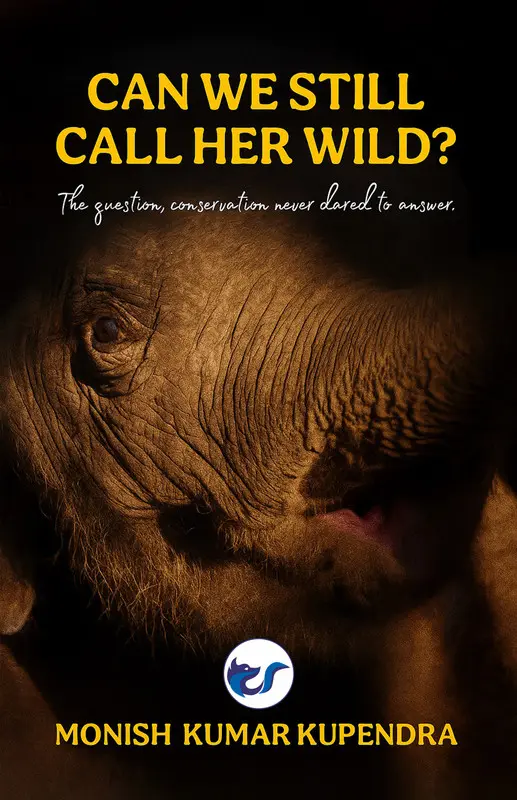


This fictional narrative follows the life history of a female Asian elephant calf born into a free-ranging wild herd in the South Indian landscape. Under the care of her experienced mother, the calf begins her early development in a socially complex and ecologically dynamic environment. However, her trajectory is abruptly altered when she is orphaned due to nature?s harsh decisions.
The orphaned calf, disoriented and vulnerable, is eventually located by forest staff and relocated to a semi-captive elephant camp. Over time, she adapts behaviorally and physiologically to life in managed conditions, an environment shaped by mahouts, biologists, and well-meaning tourists. Her development raises critical questions: What defines ?wildness?? Can conservation justify captivity? And what does a life look like when natural behaviors are constrained by human care?
Parallel to this narrative is the field journey of five undergraduate life science students conducting an elephant behavior study. Through systematic observation, and long hours in forest conditions, they are exposed to the scientific realities of wildlife research, data collection, field ethics, logistical setbacks, and emotional entanglements. Their experience challenges the perception of science as a purely academic exercise and reframes it as a deeply immersive, physical, and ethical pursuit.
Can You Still Call Her Wild? bridges storytelling and scientific inquiry to offer life science students a nuanced perspective on conservation, animal behavior, and field-based learning. It serves as a call to future scientists, to engage with nature not only intellectually, but experientially, where the forest becomes both classroom and question.
Can we still call her wild?: The question, conservation never dared to ask
Estimated delivery dates: Mar 26, 2026 - Mar 31, 2026
₹210.00
Mr. Monish Kumar Kupendra is a conservation biologist, storyteller, and passionate field researcher who has spent years immersed in the forests of South India. His work centers on the lives of elephants and the intricate web of interactions that define the wild. Deeply committed to conservation both in practice and philosophy, Monish believes that real education begins beyond the four walls of a classroom.
His motto being simple yet powerful is to drag the students out of boring classrooms and into the open fields. For him, nature is the ultimate classroom, one that opens minds, humbles hearts, and inspires responsibility. Through his writing and fieldwork, he strives to be an eye-opener for the younger generation, urging them to witness the rhythms of the natural world firsthand.
Monish firmly believes that every human being on this planet has a role to play in conservation, not just scientists and activists, but each individual, in their own way. This book is an extension of that belief which is a story crafted to stir empathy, raise questions, and awaken a deeper connection with the wild.
People Also Viewed
Description
Additional Information
| Weight | 0.35 kg |
|---|---|
| Binding Type | Paperback |
| Languages | |
| Publishers |
 No products in the cart.